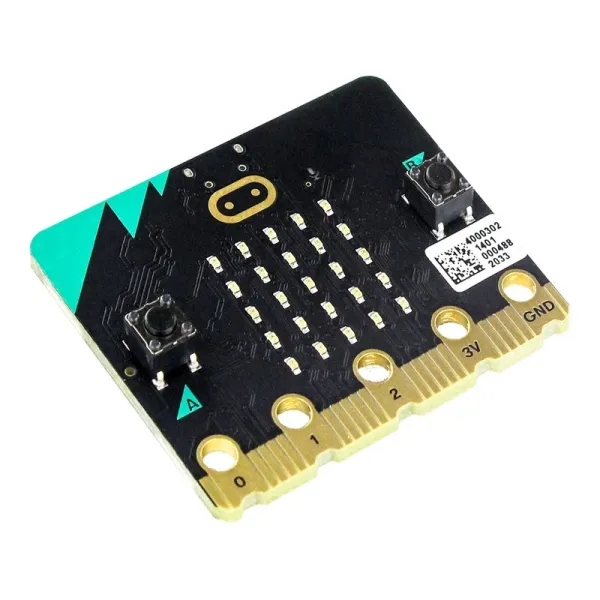
BBC micro:bit V2 board – Go bundle
Code: PG-EXT.009
BBC micro:bit V2 Go bundle with the micro:bit V2 board, USB cable, battery holder, 2 AAA batteries and quick-start guide. It is ideal for learning to code and features a 25-LED display, two programmable buttons, an accelerometer, a compass, radio communication and sound.
26,50 €
Includes 24% VAT
- Free shipping over 100,00 €
- Pickup in Patras (by appointment)
- Secure payments
- Technical support
Categories: micro:bit & STEM
Description
The BBC micro:bit V2 is a small, pocket-sized computer. You can program and customise it however you like to bring your own digital ideas, games and applications to life.
It is ideal for anyone taking their first steps in programming. The online block-based code editor is easy to use, and the board connects simply with crocodile clips. This makes it easy to program your own projects and work with electronic components.
Contents of the micro:bit GO Starter Kit:
- 1x micro:bit V2 board (random colour: red, yellow, green or blue)
- 1x USB cable for connecting to a computer
- 1x battery holder for portable projects
- 2x AAA batteries
- 1x quick-start guide
Features
- Inputs and outputs: Every computing system is based on inputs and outputs. Although very small, the BBC micro:bit has many of them, so you can learn how they work and use them with electrical components.
- LEDs: An LED (light-emitting diode) is an output device that produces light. The BBC micro:bit V2 has a display with 25 programmable LEDs.
- Buttons: Buttons are among the most common input devices. The micro:bit has two programmable buttons and a reset button.
- Radio communication: Radio waves let you send and receive messages. This means several BBC micro:bits can communicate with each other.
- Accelerometer: This is a sensor that measures movement. It detects when you tilt the board left-right, forwards-backwards and up-down, which is very useful when making games.
- Compass: The digital compass is an input sensor that detects magnetic fields. With the built-in compass, the BBC micro:bit can tell which direction it is facing.
- Light sensor: It measures how much light there is in the surroundings. The BBC micro:bit uses its LEDs to detect brightness, so you can program it to work as a light sensor.
- Temperature sensor: This is an input device that measures temperature. On the BBC micro:bit it is located inside the processor and gives an approximate value for the temperature of the air around the board.
- Pins: Along the bottom edge of the BBC micro:bit there are 25 gold strips, the pins. Through these you can build circuits, connect external components such as buzzers and motors, and create your own projects.
- Sound: You can program the BBC micro:bit to produce many different sounds: individual notes, tones, rhythms and even your own musical compositions.
- USB interface: USB (Universal Serial Bus) is used to connect, communicate with and power computers and digital devices. Via the BBC micro:bit's USB interface, you connect it to your computer with a micro USB cable and power it from there.
- Processor: The processor is considered the 'brain' of a computer. The BBC micro:bit has a microprocessor, which runs the programs you write.
Specifications
- Password
- PG-EXT.009
- Weight
- 0.05 kg